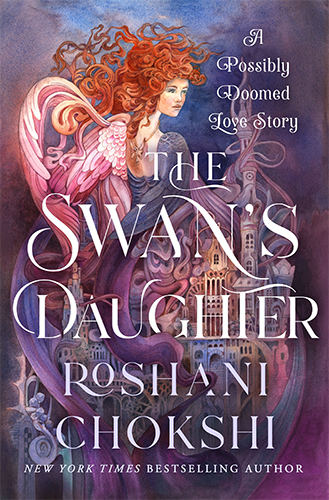
The Swan’s Daughter by Roshani Chokshi is a lavish, strange, and quietly radical fairytale retelling that takes familiar tropes and reshapes them from the inside out. On the surface, it looks like a classic setup: a young woman enters a glittering court to compete for a prince’s hand, surrounded by beautiful rivals and impossible expectations. But almost immediately, the story begins to question who holds power, who is truly at risk, and what beauty is allowed to look like in a world obsessed with spectacle. This Ugly Duckling retelling, wrapped in a Bachelor-style tournament of brides, is indulgent and whimsical, but it is also deeply intentional in the way it reframes vulnerability, worth, and agency.
They’re terrified of you, which is far more useful than affection.
Roshani Chokshi, The Swan’s Daughter
I came into this novel with high expectations because The Gilded Wolves is one of my favorite books. While The Swan’s Daughter is far frothier in tone, it carries the same confidence in its worldbuilding. This is one of the most decadent settings I have read in a fairytale retelling. Sentient castles, library wyverns disguised as rabbits, and daydream trees create a lush, storybook atmosphere, but there is always something sharp beneath the surface. The satire also works especially well here. The competition is absurd, glamorous, and dangerous in equal measure, and the book never lets you forget that performance and survival are deeply intertwined.
One of the most interesting things this book does is quietly subvert the traditional damsel narrative. Demelza arrives at the tournament of brides as someone easily overlooked. She is physically unremarkable by the court’s standards, visibly out of place among competitors who embody polished, effortless beauty. From the outside, she appears vulnerable, even pitiable. In reality, it is Prince Arris who occupies the most precarious position. His life, his future, and his very humanity hinge on making the right choice. If he chooses poorly, the consequences are catastrophic. I loved how this inversion reframes the entire competition. Demelza may look like the one in need of saving, but Arris is the one trapped by expectation and consequence.
Love is dazzling. Can you imagine it? To be entrusted with someone’s heart…to be all the radiance in their world? To be the only shelter in which they know both safety and bliss?
Roshani Chokshi, The Swan’s Daughter
Beauty is also treated with a surprising intentionality in this novel. Demelza is not revealed to be secretly stunning, nor does the narrative rush to “fix” her appearance to make her worthy. Instead, her beauty is initially internal, invisible to a society trained to value spectacle above substance. Every other competitor is outwardly beautiful in ways the court knows how to reward. Yet by the end, it becomes clear that none of them can match what Demelza offers as a person. Her honesty, emotional steadiness, and refusal to perform a version of herself for approval give the story a quiet power that will stay with readers. The novel slowly becomes less interested in beauty as currency and more invested in beauty as character.
Arris, too, is written in ways that resist traditional fairytale masculinity. I was especially drawn to the attention paid to his routines, his clothing, and the care he takes in presentation. There is something almost traditionally feminine in how these moments are framed for him and not for Demelza, and yet the story never treats this as weakness or contradiction. His sensitivity, precision, and emotional awareness exist comfortably alongside his role as prince and romantic lead. Even within the confines of a heterosexual romance, the book allows softness and attentiveness to be strengths rather than liabilities, which felt both refreshing and intentional.
Power is a matter of perception. In the end, it’s what you believe that holds the most sway. All the rationale in the world might tell you you are walking headlong into danger. But if you believe yourself an exception, if you believe that fate walks you down a different road despite every evidence to the contrary, then it is perception alone that rules you. Nothing else.
Roshani Chokshi, The Swan’s Daughter
The weakest element for me was the romance. While I appreciate that Demelza and Arris don’t experience insta-love (an annoying pitfall of many YA romances for me!), their relationship never really evolves into something convincingly romantic. Their chemistry is muted, and there is no clear emotional turning point where their feelings shift from friendship to romantic love. At times, it even feels as though the narrative invites us to root for Arris to end up with someone else. Given how central love is positioned within the story, this lack of development is disappointing.
Several plot threads also feel underresolved, particularly those involving Demelza’s father and the spell she and her sisters were raised to decipher. Both arcs are introduced with significant weight and then quietly fade away, which undermines their earlier importance.
Still, I genuinely enjoyed The Swan’s Daughter. Its greatest strength lies in how it reimagines familiar tropes without stripping them of their magic. This is a story about being underestimated, about finding worth beyond performance, and about choosing who you are in a world determined to define you first.
Thank you to NetGalley and Wednesday Books for sharing an advanced reader copy of this book in exchange for an honest review.
The Swan’s Daughter at a glance
Book details
Title: The Swan’s Daughter
Author: Roshani Chokshi
Publisher: Wednesday Books
Release Date: January 6, 2026
Page Count: 400
Synopsis
In this lush and enchanting novel from New York Times bestselling author Roshani Chokshi, a prince is only as good as his beating heart and a maiden is only as good as her honest word. But when love and the truth become impossibly tangled, the two must figure out how to survive together, or fall completely apart.
To find love is a curse…
Prince Arris knows that marriage means murder. Thanks to a poorly worded wish to a sea witch, all one needs to rule the Isle of Malys is the heart and hand of the kingdom’s heir. Historically, this has been construed quite literally.
Thus, Arris expects that the day after his marriage and murder he will wake up as a sentient tree alongside the rest of his predecessors. His only chance at a long life is finding true and lasting love. When Arris’s parents announce a tournament of brides to compete for his hand and heart, a slew of eligible, lovely and (possibly murderous) bachelorettes make their way to Rathe Castle. Amidst glittering balls in ozorald caves, strolls through menageries of daydream trees and pearl crocodiles, tea time on glass boats and kisses that leave his head spinning, Arris cannot tell who is here out of love for him…or lust for power.
Until he meets Demelza.
As a veritas swan, Demelza’s song wrings out the truth. Forced into hiding, Demelza strikes a deal. Arris will provide her with safekeeping in exchange for her truth-telling song to sort through his potential brides.
While Arris is used to dodging death threats and Demelza is accustomed to fighting for her voice to be heard, to survive the tournament of brides requires a different kind of bravery. And perhaps the bravest thing one can do is not merely protect one’s life, but find the courage to chase a life worth living.