
Book Review

Rottenheart by Kat Dunn

Rottenheart by Kat Dunn is a sapphic gothic reimagining of Hamlet set in the 1890s, following Odette after the death of her mother, Lydia. As Odette grieves, her aunt Claudine begins taking her mother’s place in the household, while her relationship with her childhood love Cecilia becomes increasingly strained, and Lydia proves considerably less gone than everyone believed. What unfolds is a story of grief, revenge, madness, complicated mother-daughter relationships, and the increasingly uncertain boundary between mourning someone and being haunted by their memory.
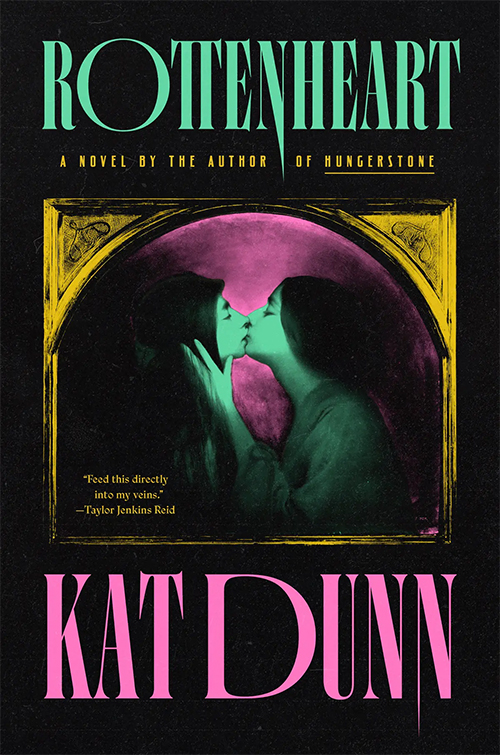
Book cover for Rottenheart by Kat Dunn.

The question is: which can she bear? The loss of self or the loss of her mother?

Kat Dunn, Rottenheart

First, I think it’s worth clarifying that although Rottenheart contains a love story, I wouldn’t approach it expecting a romance. Hamlet is a tragedy. Shakespeare’s comedies are the plays that traditionally resolve themselves through a happily ever after (i.e. marriage), and Hamlet very much is not built to deliver any kind of HEA. So Odette and Cecilia’s relationship is supposed to be complicated, unhealthy at times, and deliberately difficult to understand as something we should simply root for. I struggled with their relationship occasionally, but I also think some of that discomfort is built into the material Dunn is adapting.

One of Dunn’s most interesting changes to Hamlet is giving Lydia a much fuller life, personality, and relationship with Odette. The ghost in Hamlet exists largely to give Hamlet his impossible task: remember me, avenge me. We know relatively little about King Hamlet as a person, but Dunn gives us something much messier in Lydia. Because the novel moves between different points in Odette’s life, we meet Lydia as the living mother Odette loved, resented, and rebelled against, while also seeing how Odette remembers her after death. Grief can soften, distort, or rewrite the dead, but Rottenheart adds another layer of tension by making Lydia’s ghost a seemingly sentient presence with desires, anger, and a personality of her own. Odette, therefore, has to contend with who her mother actually was, who grief and memory are turning her into, and a ghost that refuses to let death end their relationship.

How is it possible to love and to hate the same person so completely?

Kat Dunn, Rottenheart

That mother-daughter focus transforms Hamlet’s obligation to his father into something much more intimate and psychologically tangled in Rottenheart. Odette is trying to mourn her mother while also being pulled back into the expectations, resentments, and obligations that shaped their relationship when Lydia was alive. The gothic elements of this retelling further strengthen that ambiguity. The haunting makes Odette’s grief feel physical and inescapable, while the novel’s treatment of madness makes it harder to tell where mourning ends and something supernatural begins. That uncertainty gives the story the creeping sense of dread I love so much in gothic literature.

For all the elements of the retelling that worked for me, I never felt quite as immersed in the story or its relationships as I wanted to be. The nonlinear structure was a huge part of that because the story repeatedly jumps backward and forward, and I often found myself trying to reorient myself instead of getting pulled deeper into the narrative. I also never became as emotionally invested in Odette and Cecilia as I wanted to be. I certainly don’t expect a Hamlet retelling to turn Hamlet/Ophelia into an aspirational love story. But I wanted the connection between Odette and Cecilia to affect me more than it did, especially because their relationship is one of the places where this retelling has the opportunity to reshape the original.

If a woman is to be free, she must have her own means.

Kat Dunn, Rottenheart

And maybe this is where Rottenheart ultimately fell a little short for me. Dunn’s prose is lovely, the historical and literary influences are obvious, and there are some genuinely unsettling moments as grief tips into gothic horror. But with a gender-swapped, sapphic Hamlet, I kept waiting for the adaptation to become even more transformative. I wanted more feminine rage. More interrogation of revenge, inheritance in all its forms, and what changes when Hamlet’s burden is passed from father and son to mother and daughter. Dunn absolutely edges open those doors, but I wanted her to kick a few of them down.

Overall, I liked Rottenheart, particularly as a gothic exploration of grief and the complicated ways daughters remember, resent, love, and inherit their mothers. I just found myself more interested in the possibilities of the adaptation than completely satisfied by where it ultimately took them.

Thank you to NetGalley and Zando for sharing an advanced reader copy of this book in exchange for an honest review.
Book Review

Every Exquisite Thing by Laura Steven

Every Exquisite Thing by Laura Steven is a sapphic young adult dark academia retelling of The Picture of Dorian Gray by Oscar Wilde. (There’s NO WAY I could resist a premise like that!) The novel follows Penny Paxton, who arrives at the elite Dorian Drama School convinced it will transform her into someone beautiful enough, talented enough, and unforgettable enough to matter. As the daughter of a famous supermodel, Penny already understands the brutal logic of her world: beauty is currency, and for women and girls, it can feel like the only path to power or control. But as Penny chases perfection, she quickly discovers all that glitters is not, in fact, gold. It’s something far more sinister and rotten that has been waiting to consume girls like her.

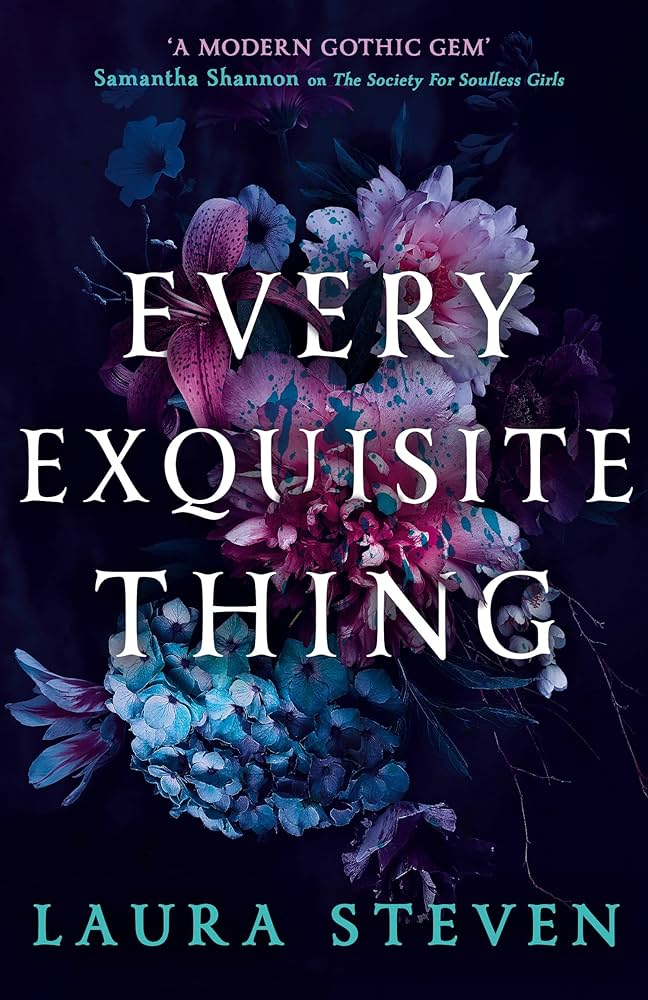
Book cover for Every Exquisite Thing by Laura Steven.

Girls want power. And sometimes beauty is the closest substitute.

Laura Steven, Every Exquisite Thing

Every classical novel has inevitably inspired retellings, reimaginings, and the occasional “what if we made this gayer?” reinvention. But the best ones don’t just swap names and settings. They figure out what made the original story endure, then twist that question toward a different wound. Every Exquisite Thing does exactly that. Steven takes the old Dorian Gray question, “what would you sacrifice to stay beautiful?” and gives it to girls who have already been taught that beauty is the thing most worth sacrificing for. Wilde’s Dorian is a beautiful young man whose face allows him to move through society untouched while his portrait bears the evidence of his corruption. Penny’s version of that bargain is different because her desire for beauty has been trained into her long before anything supernatural enters the picture. Penny wants beauty because she has inherited a world that treats it as evidence of value. The real tragedy is that she has been taught to confuse being beautiful with being worthy.

Penny is a really compelling FMC for this kind of story because her vanity is so familiar. She is ambitious, jealous, insecure, hungry, and sometimes (especially at the beginning of the novel!) so deeply unlikable I wondered how long I could sympathize with her. But as the story unfolds, it becomes harder to separate Penny’s worst impulses from the world that taught her to survive this way. She has grown up close enough to fame to understand its power, but not close enough to feel secure in it. That juxtaposition gives her obsession with beauty and perfection the rancid edge of a survival instinct gone septic. She wants the lead role. She wants the perfect body. She wants the stunning face. She wants proof that she isn’t just someone’s daughter. And Steven is very good at showing how that desperation can curdle into cruelty without flattening Penny into a cautionary tale.

My grandmother, meticulously measuring herself with a pink dressmaker’s tape, and my mother, observing, internalizing. A generational curse passed down like a set of ancient pearls, impossible to escape from once they were hanging around your neck.

Laura Steven, Every Exquisite Thing

One of my favorite parts of Every Exquisite Thing is how pointed the Shakespeare productions feel in a story about girls learning which versions of themselves are allowed to exist. Steven is reimagining Wilde rather than simply performing Dorian Gray back to us, while the students are doing the opposite with Shakespeare: stepping into scripts that have already been written, studied, admired, and repeated for centuries. So the school’s emphasis on performance goes far beyond the stage. Everyone is learning how to fit themselves into roles other people already understand. Penny’s casting as Lady Macbeth makes that even more pointed. Lady Macbeth knows what it means to want power from a position where she cannot simply claim it outright, and Penny is rehearsing that same impossible lesson: how to want something without being punished for wanting too much.

I also really liked that the sapphic relationships are not treated like a glossy update to a classic text. They are messy, charged, and tangled up in the same questions of beauty, wanting, and self-image that shape the rest of the novel. The Picture of Dorian Gray has always felt deeply queer to many readers, even when its queerness lives in implication, obsession, secrecy, and the fear of being exposed. Every Exquisite Thing brings that desire into the open. In a world where girls are constantly taught to measure themselves through desirability, attraction can blur very quickly with admiration, envy, rivalry, and hunger. Sometimes these characters want each other. Sometimes they want to beat each other. Sometimes they want to become each other. And sometimes all of that is happening at once. Queerness here is not an escape from the beauty economy. It disrupts it and shows how difficult it can be to desire someone clearly when you have been taught to compare yourself to everyone.

I was so perfect before the world told me otherwise.

Laura Steven, Every Exquisite Thing

The portrait itself also gets a smart modern update. Wilde’s portrait can be hidden away, left to rot in private, while Dorian’s face remains untouched. Steven understands that contemporary image culture does not work like that. In Penny’s world, beauty is documented, circulated, screenshotted, weaponized, and preserved by everyone with a phone. A photograph can be evidence, social currency, punishment, or proof of who someone is supposed to be. That makes the portraits feel even stranger when they appear because they’re not just gothic decoration. They are part of a much larger ecosystem of images haunting these girls from every angle. Mirrors, photos, paparazzi shots, portraits on the wall—all of them become versions of the same question: what happens when the image becomes more powerful than the person it claims to capture?

By the end, Steven has created a retelling that feels more like excavation than homage. She does not simply ask, “What if Dorian Gray were sapphic?” Instead, she imagines what Dorian Gray becomes in a world where girls are taught to curate themselves before they know who they are, and where beauty is marketed as empowerment while still being used as a leash. The result is gothic, bitter, romantic, and vicious in all the right places. I absolutely devoured this book, and so will you!

Thank you to NetGalley and Wednesday Books for sharing an advanced reader copy of this book in exchange for an honest review.