Book Review

Empire of Flame and Thorns by Marion Blackwood

Empire of Flame and Thorns by Marion Blackwood is an enemies-to-lovers romantasy where a fae girl enters a series of deadly trials for a chance at freedom. It’s set in a world where dragon shifters rule, justifying their dominance over fae through stories of a half-remembered past where the fae once held power over the dragon shifters, though neither side truly remembers how or why that world ended. Now, the fae live under tight control, their choices limited, their futures dictated. But every 150 years, the Atonement Trials offer three winners the chance to leave this oppressive system. Selena Hale enters the trials not just for her own survival and freedom, but for the possibility of helping the fae rebellion in a way she never could from within.
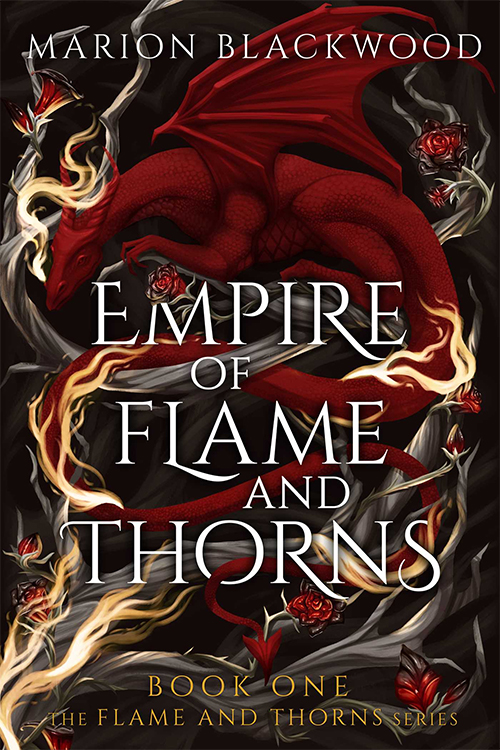
Book cover for Empire of Flame and Thorns by Marion Blackwood.

Because fear is a weapon. It gives other people power over you without them even having to do anything.

Marion Blackwood, Empire of Flame and Thorns

This is one of those books that pulls you forward through sheer momentum alone. The trials are chaotic by design, governed only by whatever rules the dragon shifters decide to enforce in the moment. That instability raises the stakes immediately, especially because the fae are not competing for glory or status, but for their lives. The intensity never settles into a predictable rhythm either. Instead, each challenge forces Selena to adapt, and the reader is right there with her, recalibrating what survival even looks like from one trial to the next.

Selena is a compelling protagonist, in part because her growth feels as much internal as it is external. She enters the trials with something to prove, not just to the world around her, but to herself. Her ability to manipulate emotions has made her an outsider among her own people, leaving her caught between wanting connection and knowing she makes others uneasy. That tension carries into how she moves through the trials. She wants to be liked and accepted, but she also has to learn how to prioritize her own survival and sense of self. Watching Selena begin to prioritize herself, trust her instincts, and own her power rather than ignore or diminish it is one of the most satisfying arcs in the book. By the final trials, both Selena and the reader have a clearer understanding of what her abilities can do and why they matter.

You do seem to have an unhealthy obsession with tracking me down in empty corridors. Can I suggest a hobby instead? Perhaps knitting since you’re so fond of pointy sticks.

Marion Blackwood, Empire of Flame and Thorns

Selena and Draven’s dynamic works because it disrupts expectations from the very beginning. Their first encounter sets the tone, with Selena turning what should be a moment of danger into something chaotic and unexpectedly funny. That same energy carries into the trials, where their back-and-forth builds on that initial clash and gradually becomes something else as their connection deepens. The banter is quick and does more than just entertain us, as there’s always an undercurrent of tension shaped by the fact that Draven holds power within the system that controls Selena. He reads as distinctly morally grey, shifting in ways that are hard to fully understand until later, which gives the enemies-to-lovers arc its edge.

The story’s deeper potential lies in its suggestion that power is less about truth and more about who controls the narrative of the past. The idea that the dragon shifters’ rule is justified by a history no one fully remembers raises a larger question about inherited narratives and how they are used to sustain systems of power. Both sides are operating on stories that have been passed down, shaped and reshaped over time, until they function less as truth and more as justification. There are moments where the text gestures toward this, particularly in how the fae themselves question the legitimacy of their oppression, but it stops short of fully engaging with it. There’s a deeper conversation here about cycles of violence, about how long a debt can be carried across generations, and who ultimately pays for it. I hope these early threads are laying the groundwork for something more fully realized in future installments.

I don’t care if you hate me. Truth be told, I kind of hate you too. And that’s why I don’t hold back when I talk to you.

Marion Blackwood, Empire of Flame and Thorns

Overall, this is an action-packed, immersive, and fun romantasy that rewards paying attention, even when you’re not entirely sure what you’re noticing. There’s a steady sense that something isn’t adding up, and the final plot twist brings that unease into sharp focus. It doesn’t tie things up so much as it opens them further, leaving a lot still to explore, both in terms of character and the larger stakes. One thing I know for sure is that I’ll be picking up book 2. I need to see what happens after that ending!

Thank you to NetGalley and Scarlett Press for sharing an advanced reader copy of this book in exchange for an honest review.
Book Review

My Roommate from Hell by Cale Dietrich

My Roommate from Hell by Cale Dietrich is a YA paranormal romance where an anxious college freshman discovers his new roommate is literally the Prince of Hell, sent to Earth through a supernatural exchange program meant to foster peace between the two realms. Owen Greene arrives at Point University with a careful plan: keep his scholarship, get good grades, secure a coveted internship, and avoid unnecessary chaos. That plan immediately unravels when Zarmenus Bloodletter moves into the other half of his dorm room. Zar’s arrival brings demon cats, accidental fires, and chaotic dorm life into Owen’s carefully structured world, forcing him to navigate supernatural diplomacy, roommate drama, and feelings he definitely did not plan for.

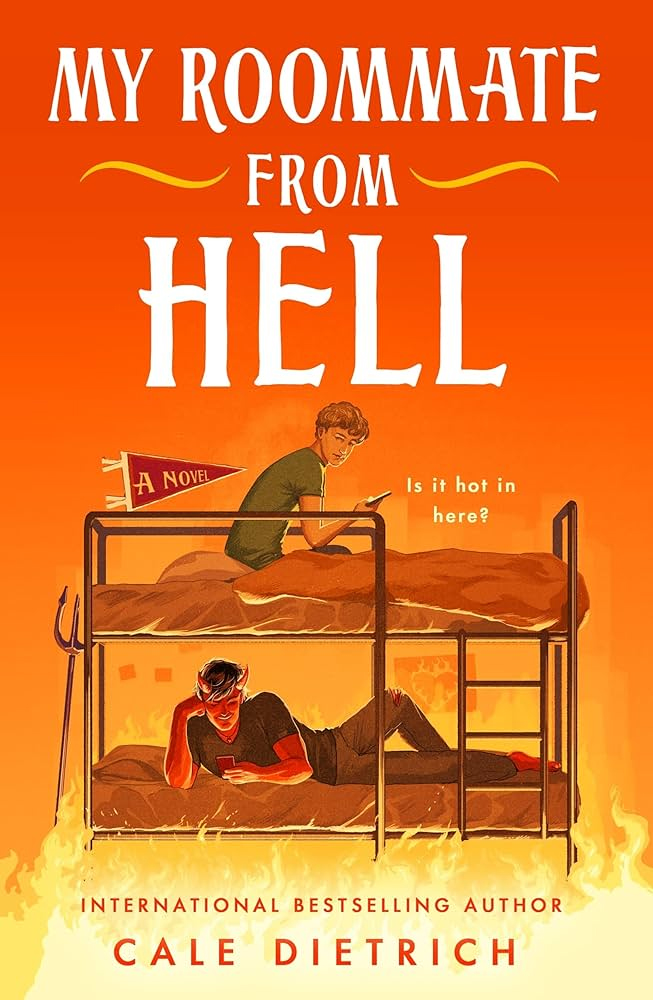
Book cover for My Roommate from Hell by Cale Dietrich.

He is chaos, I am order. We make no sense.

Cale Dietrich, My Roommate from Hell

The first part of the novel leans heavily into this odd-couple roommate dynamic, and it’s where the book finds much of its humor. Owen’s anxious inner monologue is genuinely funny, especially as he tries to rationalize the increasingly ridiculous situations unfolding around him. His disbelief at demon cats, ghostly mishaps, and Zar’s complete lack of human etiquette makes for several laugh-out-loud moments. The funniest part is that most of Owen’s issues are actually about common roommate quibbles, and not the demonic surprises that keep popping up!

At the same time, this early section is also where the pacing struggles the most. The first half of the book centers on Zar’s messy, disruptive behavior, but also on Owen’s repeated refusal to confront him about it. Instead, Owen cycles through a familiar internal pattern: he decides he’ll talk to Zar tomorrow, worries about ruining their relationship, convinces himself it’s not that bad, and ultimately says nothing. Because his ability to secure an important internship depends on getting along with his supernatural roommate, Owen keeps giving Zar “one more chance,” even going so far as to clean their room for him. The result is that the conflict becomes repetitive. Oddly enough, Zar’s antics are less frustrating than Owen’s refusal to simply talk to his roommate and communicate his issues.

Point’s most famous exchange student might be a demon, but he’s not Satan. There’s a difference.

Cale Dietrich, My Roommate from Hell

Once the story reaches the fake dating plotline, the tone shifts into something softer and more romantic. In order to smooth over some supernatural complications, Owen and Zar decide to pretend they’re a couple. Watching them construct elaborate schemes to convince other students that their relationship is real leads to several sweet and awkward moments, and the premise taps into the classic appeal of the fake dating trope. This section has a lot of charm, but the execution feels slightly uneven.

The fake dating storyline begins fairly late in the book, and there’s relatively little one-on-one interaction between the Owen and Zar before it starts. Much of the first half focuses solely on Owen navigating dorm life, dining halls, and the overwhelming experience of starting college while trying to make new friends. Those slice-of-life moments do capture the awkward uncertainty of freshman year well, especially Owen’s anxiety about socializing after the first week of school. His personality as a chronic worrier paired with quiet optimism about college is easy to recognize, particularly for anyone who remembers how strange those early college days can feel. But the transition from that, into the fake dating part of the story that more actively involves Zar feels a bit disjointed, particularly after Owen spends so much effort avoiding interactions with his roommate.

I don’t know what kind of game he’s playing, and admitting that yes, I do find him, at least superficially, extremely attractive, feels like a bad move.

Cale Dietrich, My Roommate from Hell

Ironically, once the romance begins, the pacing speeds up too much. Many of Owen and Zar’s more intimate conversations or emotional turning points happen off-page or in quick time skips. Instead of lingering on the yearning, confusion, and “wait, is this still fake?” tension that often makes fake dating stories so satisfying, the story focuses primarily on how they present their relationship in public.

Even with those pacing issues, My Roommate from Hell is still a fun and surprisingly wholesome read. The demon mythology adds a playful supernatural twist to what is otherwise a recognizable college coming-of-age story. Beneath the chaos and humor, the book ultimately centers on Owen learning how to stand up for himself, navigate independence, and figure out what it means to grow into adulthood. The result is a story that feels devilishly fun, occasionally messy, and easy to enjoy, especially for readers who can appreciate the sweetness of a cozy and queer paranormal romance.

Thank you to NetGalley and Wednesday Books for sharing an advanced reader copy of this book in exchange for an honest review.
Book Review

The Swan’s Daughter by Roshani Chokshi

The Swan’s Daughter by Roshani Chokshi is a lavish, strange, and quietly radical fairytale retelling that takes familiar tropes and reshapes them from the inside out. On the surface, it looks like a classic setup: a young woman enters a glittering court to compete for a prince’s hand, surrounded by beautiful rivals and impossible expectations. But almost immediately, the story begins to question who holds power, who is truly at risk, and what beauty is allowed to look like in a world obsessed with spectacle. This Ugly Duckling retelling, wrapped in a Bachelor-style tournament of brides, is indulgent and whimsical, but it is also deeply intentional in the way it reframes vulnerability, worth, and agency.

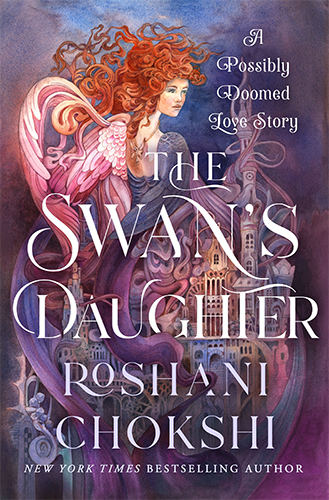
Book cover for The Swan's Daughter by Roshani Chokshi.

They’re terrified of you, which is far more useful than affection.

Roshani Chokshi, The Swan’s Daughter

I came into this novel with high expectations because The Gilded Wolves is one of my favorite books. While The Swan’s Daughter is far frothier in tone, it carries the same confidence in its worldbuilding. This is one of the most decadent settings I have read in a fairytale retelling. Sentient castles, library wyverns disguised as rabbits, and daydream trees create a lush, storybook atmosphere, but there is always something sharp beneath the surface. The satire also works especially well here. The competition is absurd, glamorous, and dangerous in equal measure, and the book never lets you forget that performance and survival are deeply intertwined.

One of the most interesting things this book does is quietly subvert the traditional damsel narrative. Demelza arrives at the tournament of brides as someone easily overlooked. She is physically unremarkable by the court’s standards, visibly out of place among competitors who embody polished, effortless beauty. From the outside, she appears vulnerable, even pitiable. In reality, it is Prince Arris who occupies the most precarious position. His life, his future, and his very humanity hinge on making the right choice. If he chooses poorly, the consequences are catastrophic. I loved how this inversion reframes the entire competition. Demelza may look like the one in need of saving, but Arris is the one trapped by expectation and consequence.

Love is dazzling. Can you imagine it? To be entrusted with someone’s heart…to be all the radiance in their world? To be the only shelter in which they know both safety and bliss?

Roshani Chokshi, The Swan’s Daughter

Beauty is also treated with a surprising intentionality in this novel. Demelza is not revealed to be secretly stunning, nor does the narrative rush to “fix” her appearance to make her worthy. Instead, her beauty is initially internal, invisible to a society trained to value spectacle above substance. Every other competitor is outwardly beautiful in ways the court knows how to reward. Yet by the end, it becomes clear that none of them can match what Demelza offers as a person. Her honesty, emotional steadiness, and refusal to perform a version of herself for approval give the story a quiet power that will stay with readers. The novel slowly becomes less interested in beauty as currency and more invested in beauty as character.

Arris, too, is written in ways that resist traditional fairytale masculinity. I was especially drawn to the attention paid to his routines, his clothing, and the care he takes in presentation. There is something almost traditionally feminine in how these moments are framed for him and not for Demelza, and yet the story never treats this as weakness or contradiction. His sensitivity, precision, and emotional awareness exist comfortably alongside his role as prince and romantic lead. Even within the confines of a heterosexual romance, the book allows softness and attentiveness to be strengths rather than liabilities, which felt both refreshing and intentional.

Power is a matter of perception. In the end, it’s what you believe that holds the most sway. All the rationale in the world might tell you you are walking headlong into danger. But if you believe yourself an exception, if you believe that fate walks you down a different road despite every evidence to the contrary, then it is perception alone that rules you. Nothing else.

Roshani Chokshi, The Swan’s Daughter

The weakest element for me was the romance. While I appreciate that Demelza and Arris don’t experience insta-love (an annoying pitfall of many YA romances for me!), their relationship never really evolves into something convincingly romantic. Their chemistry is muted, and there is no clear emotional turning point where their feelings shift from friendship to romantic love. At times, it even feels as though the narrative invites us to root for Arris to end up with someone else. Given how central love is positioned within the story, this lack of development is disappointing.

Several plot threads also feel underresolved, particularly those involving Demelza’s father and the spell she and her sisters were raised to decipher. Both arcs are introduced with significant weight and then quietly fade away, which undermines their earlier importance.

Still, I genuinely enjoyed The Swan’s Daughter. Its greatest strength lies in how it reimagines familiar tropes without stripping them of their magic. This is a story about being underestimated, about finding worth beyond performance, and about choosing who you are in a world determined to define you first.

Thank you to NetGalley and Wednesday Books for sharing an advanced reader copy of this book in exchange for an honest review.
Book Review

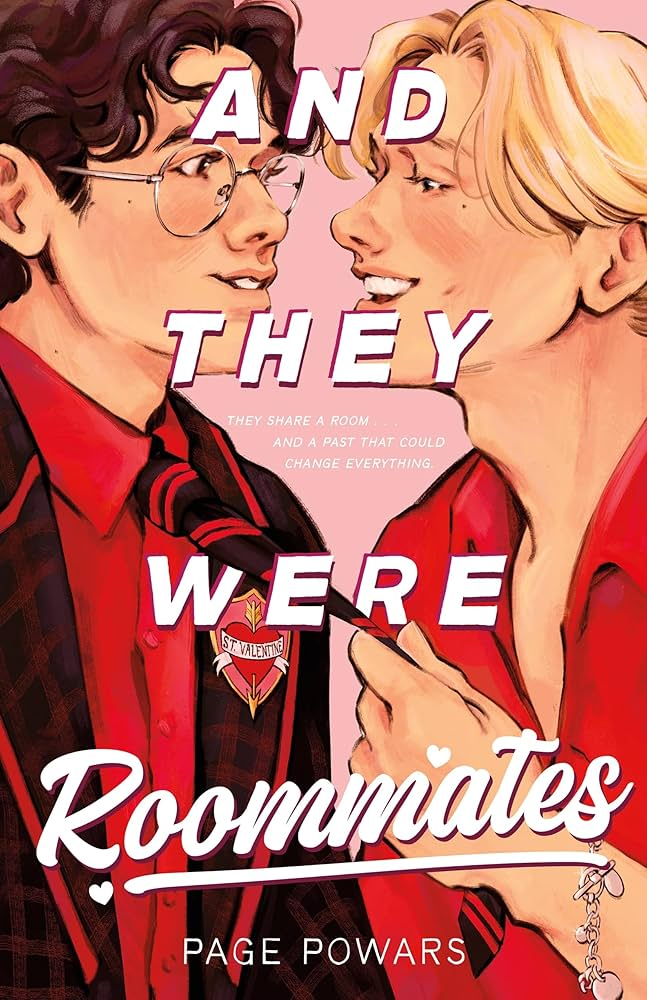
And They Were Roommates by Page Powars

And They Were Roommates by Page Powars is a YA romantic comedy set at an all-boys boarding school, wrapped in Valentine’s Day antics, secret love letters, and the heightened emotions of being 16 and figuring yourself out. I went into this one with high expectations, partly because I love most things associated with the meme the title originates from, and partly because of the trans representation at its center. And we get all of that! This book is charming and genuinely sweet, but it’s also uneven, overly silly at times, and emotionally thinner than I wanted it to be. I kept wishing it would go deeper and let the characters linger in some of the heavier, more real moments instead of constantly playing to the bit.

Book cover for And They Were Roommates by Page Powars.

I’d been drawn to those boys because I wanted to be a boy. Because I was a boy.

Page Powars, And They Were Roommates

One of the strongest aspects of the book is Charlie as a protagonist, particularly in how his internal anxieties are portrayed. Powars does a good job capturing the hypervigilance that can come with being trans in spaces that don’t always feel safe or fully welcoming. Charlie’s fear isn’t rooted in shame about who he is, but in the very real concern of being scrutinized, questioned, or denied the ability to exist comfortably as himself

Jasper, on the other hand, was where the romance really lost me. As a love interest, he often came across as more irritating than intriguing, and I struggled to understand what originally drew Charlie to him so strongly. The book hinges on their shared past at summer camp and frames their relationship as a meaningful second-chance romance, but when that first chance happened at 13, it’s difficult to buy the depth and permanence of that bond. I tend to be skeptical of second-chance romance in YA for this reason, and this book didn’t quite convince me otherwise. The emotional stakes felt inflated without enough concrete backstory to support them.

Love is never not scary. It’s a matter of whether you’re enjoying that fear.

Page Powars, And They Were Roommates

Tonally, this novel leans hard into whimsy. The Valentine Academy setting, the anonymous love letter delivery service, and the heightened drama all gave me strong K-drama, J-drama, and even manga vibes (I kept thinking of Hana-Kimi!). That aesthetic can be very fun, and at times it absolutely worked. I loved the classic all-boys boarding school atmosphere, but that sense of contained chaos taken together sometimes overwhelmed the emotional throughline. Too many subplots were introduced, and not enough of them received satisfying closure by the end.

The love-letter premise is a good example of this. Charlie and Jasper writing anonymous romantic letters for their classmates creates plenty of angst and comedic mishaps, but the plot never quite lands its point. I expected the story to resolve this either by empowering students to write their own letters or by fundamentally changing the relationship between the two campuses. Instead, the thread simply fizzles out, leaving me unsure what the point was, beyond fueling drama.

Overall, And They Were Roommates is sweet, sincere, and full of queer joy. Readers who love exaggerated rom-com energy, boarding school settings, and lighthearted YA romance may have a great time with it. For me, though, the characterization needed more grounding, and the romance never really earns its emotional payoff. Still, I’m glad this book exists, and I hope it finds the readers who will adore it.

Thank you to NetGalley and Roaring Brook Press / Macmillan Children’s Publishing Group for sharing an advanced reader copy of this book in exchange for an honest review.

Book Review

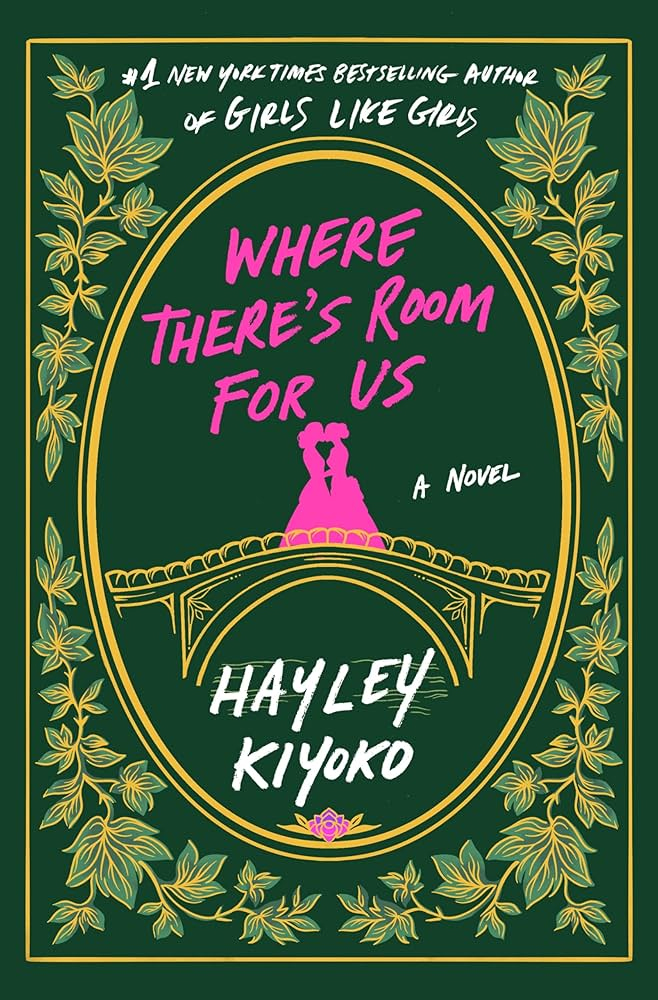
Where There’s Room for Us by Hayley Kiyoko

In a reimagined 1880s England where same-sex love is accepted yet the patriarchy still rules, Hayley Kiyoko delivers a tender romance between two young women navigating the tension between selfhood and social expectation. Where There’s Room for Us follows Ivy, an outspoken poet from New York who relocates to England, and Freya, a dutiful socialite who’s expected to marry a lord and produce heirs in order to secure her family’s legacy. What begins as curiosity quickly deepens into a slow-burn sapphic romance filled with charm, social commentary, and a quiet but persistent sense of rebellion as Ivy and Freya begin to imagine a life that might finally be their own—if they can bear the cost of claiming it.

Book cover for Where There's Room for Us by Hayley Kiyoko.

It’s not every day a whole prime minister accuses you of being a harbinger of sapphic doom.

Hayley Kiyoko, Where There’s Room for Us

Ivy and Freya feel like two different versions of girlhood crashing into each other at the exact right moment. Ivy already knows who she is. She’s flirtatious, outspoken, comfortable sinking into her love for women without apology. She walks into a room and you can practically feel all the air shift her way. Freya, by contrast, has spent her life doing what she is told and calling it love. She reveres her father and plans to marry Lord Montgomery because that is the path laid out for her. But when she meets Ivy, she has to name what she wants for the first time in her life, and that awakening is honestly so satisfying.

Freya’s mostly peripheral relationship with her father is also more layered than I expected. She loves him and wants his approval, but eventually begins to see that his approval comes with a cost she can no longer keep paying. He is obsessed with securing an heir who can inherit his title, and because he only has daughters, he pushes Freya toward a marriage she does not want. There is one particular moment when he discovers how Freya feels about Ivy, and his reaction is ugly. Freya runs, and for one fleeting instant, she imagines what might have happened if her sister hadn’t found her and taken her in, how easily she could have been left with nowhere to go. That brief beat in the story brushes against something painfully real for many queer readers: the fear of losing home, safety, and family simply for being honest about who they are. Kiyoko weaves moments like this throughout the story, grounding the romance in quiet echoes of real-world anxieties and creating an emotional connection that feels both tender and true.

What a thing, to just be accepted like she belongs.

Hayley Kiyoko, Where There’s Room for Us

By removing homophobia from this fictional world yet leaving sexism intact, Kiyoko forces readers to see how privilege and oppression can coexist within the same structures. It reframes Victorian England through a speculative lens that feels both fresh and hauntingly recognizable. Marriage equality exists, but equality itself does not. A woman may love another woman, but she cannot inherit her father’s title or estate because that privilege is only afforded to men. This results in an intriguing tension between freedom and frustration, where Ivy and Freya’s hearts are liberated but their fates are not. It’s a subtle but biting commentary on how reform without equality still reinforces old hierarchies.

The romance is where the book falters slightly. Ivy and Freya are undeniably sweet, sometimes so sugary it almost made my teeth ache. Their early scenes together are tender and full of kissing in gardens, along forest paths, against trees—everywhere—and while that has its charm, I kept wishing for a little more tension beneath all that softness. Time jumps also rush past key emotional turns. Conflicts flare, confessions are made, family drama erupts, and then suddenly it’s two weeks later and everything has quietly resolved itself. I wanted to linger in those rough edges and actually see Ivy and Freya fight for what they keep saying is worth everything.

The novel’s closed-door romance approach adds to that sense of restraint. It’s likely a deliberate choice to make the story accessible to younger readers, and that’s understandable, but it leaves a noticeable gap between what’s shown and what’s implied.

If security comes at the cost of your soul, then it is not a choice you can make freely.

Hayley Kiyoko, Where There’s Room for Us

For all its emotional depth, the story’s conclusion feels too tidy and rushed. Some conflicts wrap up too neatly, and some emotional threads, especially between Freya and her father, never really get revisited. I kept waiting for the book to force her father to face his hypocrisy, but instead, he is mostly allowed to stay himself. On one hand, that is realistic. A lot of queer readers know exactly what it’s like to love a parent who will never meet you in the middle. On the other hand, I wish the story spelled out what that means for Freya long term. Sometimes I want to see plots like that buttoned up in fiction since real life isn’t required to make sense or be fair. Alas!

Still, this book reads like a love letter to queer readers. Ivy and Freya are adorable together, but it’s the context around their romance—the inheritance laws, the rigid gender roles, the quiet heartbreak of disappointing a beloved parent simply for being who you are—that really resonates. Kiyoko’s world doesn’t fix everything, but it gives us space to imagine better. And for that alone, it’s worth a read.

Thank you to NetGalley and Wednesday Books for sharing an advanced reader copy of this book in exchange for an honest review.