
Book Review

My Roommate from Hell by Cale Dietrich

My Roommate from Hell by Cale Dietrich is a YA paranormal romance where an anxious college freshman discovers his new roommate is literally the Prince of Hell, sent to Earth through a supernatural exchange program meant to foster peace between the two realms. Owen Greene arrives at Point University with a careful plan: keep his scholarship, get good grades, secure a coveted internship, and avoid unnecessary chaos. That plan immediately unravels when Zarmenus Bloodletter moves into the other half of his dorm room. Zar’s arrival brings demon cats, accidental fires, and chaotic dorm life into Owen’s carefully structured world, forcing him to navigate supernatural diplomacy, roommate drama, and feelings he definitely did not plan for.
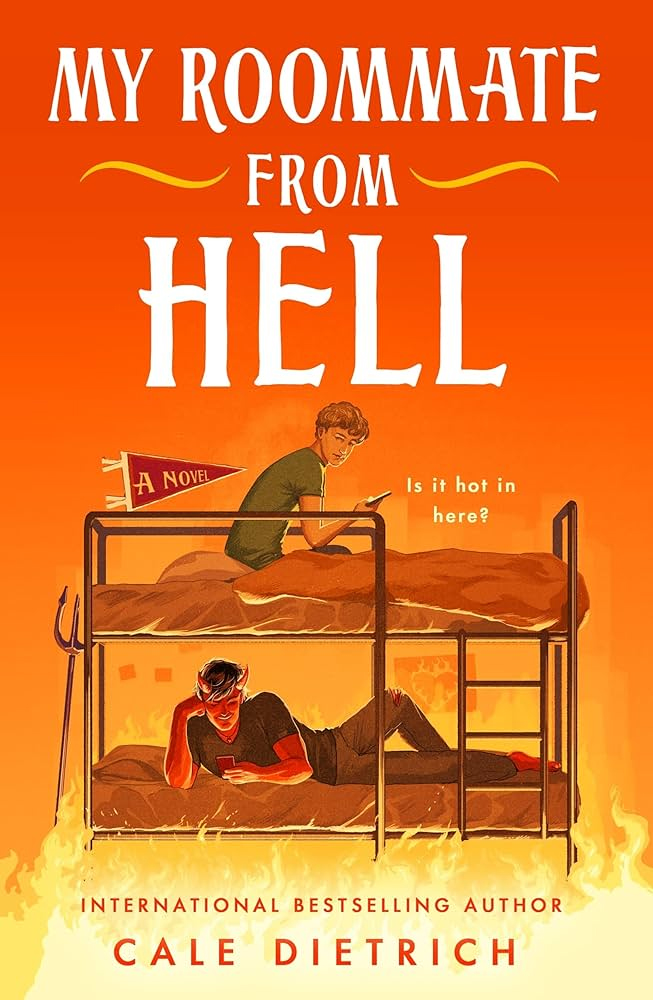
Book cover for My Roommate from Hell by Cale Dietrich.

He is chaos, I am order. We make no sense.

Cale Dietrich, My Roommate from Hell

The first part of the novel leans heavily into this odd-couple roommate dynamic, and it’s where the book finds much of its humor. Owen’s anxious inner monologue is genuinely funny, especially as he tries to rationalize the increasingly ridiculous situations unfolding around him. His disbelief at demon cats, ghostly mishaps, and Zar’s complete lack of human etiquette makes for several laugh-out-loud moments. The funniest part is that most of Owen’s issues are actually about common roommate quibbles, and not the demonic surprises that keep popping up!

At the same time, this early section is also where the pacing struggles the most. The first half of the book centers on Zar’s messy, disruptive behavior, but also on Owen’s repeated refusal to confront him about it. Instead, Owen cycles through a familiar internal pattern: he decides he’ll talk to Zar tomorrow, worries about ruining their relationship, convinces himself it’s not that bad, and ultimately says nothing. Because his ability to secure an important internship depends on getting along with his supernatural roommate, Owen keeps giving Zar “one more chance,” even going so far as to clean their room for him. The result is that the conflict becomes repetitive. Oddly enough, Zar’s antics are less frustrating than Owen’s refusal to simply talk to his roommate and communicate his issues.

Point’s most famous exchange student might be a demon, but he’s not Satan. There’s a difference.

Cale Dietrich, My Roommate from Hell

Once the story reaches the fake dating plotline, the tone shifts into something softer and more romantic. In order to smooth over some supernatural complications, Owen and Zar decide to pretend they’re a couple. Watching them construct elaborate schemes to convince other students that their relationship is real leads to several sweet and awkward moments, and the premise taps into the classic appeal of the fake dating trope. This section has a lot of charm, but the execution feels slightly uneven.

The fake dating storyline begins fairly late in the book, and there’s relatively little one-on-one interaction between the Owen and Zar before it starts. Much of the first half focuses solely on Owen navigating dorm life, dining halls, and the overwhelming experience of starting college while trying to make new friends. Those slice-of-life moments do capture the awkward uncertainty of freshman year well, especially Owen’s anxiety about socializing after the first week of school. His personality as a chronic worrier paired with quiet optimism about college is easy to recognize, particularly for anyone who remembers how strange those early college days can feel. But the transition from that, into the fake dating part of the story that more actively involves Zar feels a bit disjointed, particularly after Owen spends so much effort avoiding interactions with his roommate.

I don’t know what kind of game he’s playing, and admitting that yes, I do find him, at least superficially, extremely attractive, feels like a bad move.

Cale Dietrich, My Roommate from Hell

Ironically, once the romance begins, the pacing speeds up too much. Many of Owen and Zar’s more intimate conversations or emotional turning points happen off-page or in quick time skips. Instead of lingering on the yearning, confusion, and “wait, is this still fake?” tension that often makes fake dating stories so satisfying, the story focuses primarily on how they present their relationship in public.

Even with those pacing issues, My Roommate from Hell is still a fun and surprisingly wholesome read. The demon mythology adds a playful supernatural twist to what is otherwise a recognizable college coming-of-age story. Beneath the chaos and humor, the book ultimately centers on Owen learning how to stand up for himself, navigate independence, and figure out what it means to grow into adulthood. The result is a story that feels devilishly fun, occasionally messy, and easy to enjoy, especially for readers who can appreciate the sweetness of a cozy and queer paranormal romance.

Thank you to NetGalley and Wednesday Books for sharing an advanced reader copy of this book in exchange for an honest review.
Book Review

The Death of Jane Lawrence by Caitlin Starling

The Death of Jane Lawrence by Caitlin Starling is a horror story built on a foundation of traditional gothic elements. The novel opens with Jane Shoringfield, a pragmatic and mathematically gifted woman who negotiates her own marriage of convenience to Dr. Augustine Lawrence to ensure her continued security and independence. The good doctor only has one request—that Jane spends her nights in a room above his surgery, and he in his labyrinthine home at Lindridge Hall. But that’s easier said than done, and Jane finds herself in Lindridge Hall on her wedding night, where she quickly discovers her new husband is hiding disturbing secrets about his past. That’s only the beginning of her troubles.

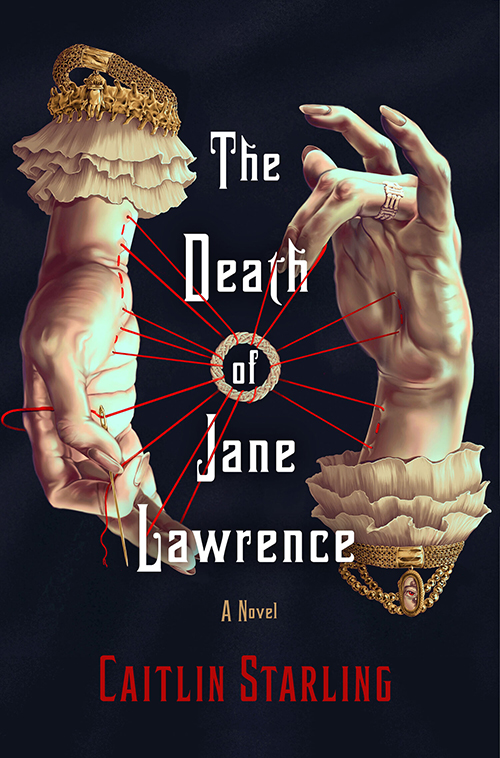
Book cover for The Death of Jane Lawrence by Caitlin Starling

She wanted Augustine to be who she’d thought he was. That man would not have lied. That man would have confided in her.

Caitlin Starling, The Death of Jane Lawrence

A problem solver by nature, Jane is doggedly determined to save her husband from the vagaries of his eerie family home, even as they become more and more unexplainable. Regardless, she persists, and it is her resolve that makes her relatable if not likable. The most interesting part of Jane’s character arc is the way she questions her own monstrousness from the very beginning. At first, it’s because she fears she’s focused too heavily on logic over emotion, but as the story progresses, Jane succumbs many times to emotional whims, and interestingly enough, it is only then she becomes unrecognizable. Was she a monster before? Or is The Death of Jane Lawrence the origin story of the monster she becomes?

Starling’s use of magic as a metaphysical concept that challenges Jane’s logical and orderly view of the world is fascinating. As Jane methodically deconstructs and revises what she knows to be true, readers settle into an understanding of how magic is meant to function in Starling’s novel. Particularly creative is Starling’s use of the concept of zero as “everything and nothing,” which serves as the backbone for her depiction of magic. However, I wish Starling had done more to explain the greater role magic plays in her fictional world and why physicians, in particular, practice it. Perhaps it’s meant to parallel the arguably god-like role they take in attempting to cure or reverse injuries and illnesses. Even so, considering Jane manages to learn magic, surely physicians aren’t the only ones who practice. How common is magic in this world? It’s difficult to tell, given Jane’s humble upbringing.

Zero…an empty nothingness, but a nothingness that went on forever, for nothing could have no bounds. The infinite and zero were one. Except that the infinite was the greatest thing in the world, and zero was nothing at all. They were opposite. They were the same.

Caitlin Starling, the Death of Jane Lawrence

Starling’s prose is melodramatic and overwrought, which at first does wonders to establish the picturesque scenery of a gloomy little town in an alternate version of post-war England. However, this strength becomes a weakness during the second half of the novel, where it often feels as though readers could skip pages at a time without losing a sense of the overall plot. The extremely redundant nature of the seven-day spell Jane casts at one point was particularly tedious to read. In general, the prose is beautiful, the details unsettling and gruesome and delightfully spooky, but they’re truly unnecessary after a certain point. Kill your darlings, as they say.

The final “revelation,” which occurs in one particular chapter near the end of the novel, closes the loop with regards to several plot points that seem misleading or arbitrary until readers are plunged into that chapter. It is deeply satisfying…until the novel just keeps going! The Death of Jane Lawrence would’ve been so much spookier if everything had ended right after the revelation. I almost thought that’s where it all ended until I turned the page! Nevertheless, the actual ending is unsettling in its own right. In proper gothic fashion, readers reach the conclusion and wonder how much of it was real and whether the supernatural elements can or should be rationalized. That’s one of my favorite elements in gothic literature, and Starling executes it so well.

A magician gets what she asks for, whether she meant to ask for it or not.

Caitlin Starling, The Death of Jane Lawrence

The Death of Jane Lawrence is a creative take on gothic literature and boasts some of the creepiest scares I’ve seen recently in a novel, especially towards the beginning, when suspense is at an all-time high. I couldn’t walk past reflective surfaces at night for nearly a week without fretting a little! However, the dense prose and excessive, rambling explanations to validate the pseudo-science behind the magic only disorients the reader and makes the second half of the story drag. Despite my misgivings, it is worth checking out if you enjoyed Silvia Moreno-Garcia’s Mexican Gothic, yet another novel that puts a modern spin on the horror-gothic mash-up with a deliciously slow and suspenseful exploration of the uncanny, or other familiar gothic stories like Edgar Allan Poe’s “The Fall of the House of Usher,” Edith Wharton’s “The Lady’s Maid’s Bell,” or Henry James’ The Turn of the Screw.

Thank you to NetGalley and St. Martin’s Press for sharing an advanced reader copy of this book in exchange for an honest review.