
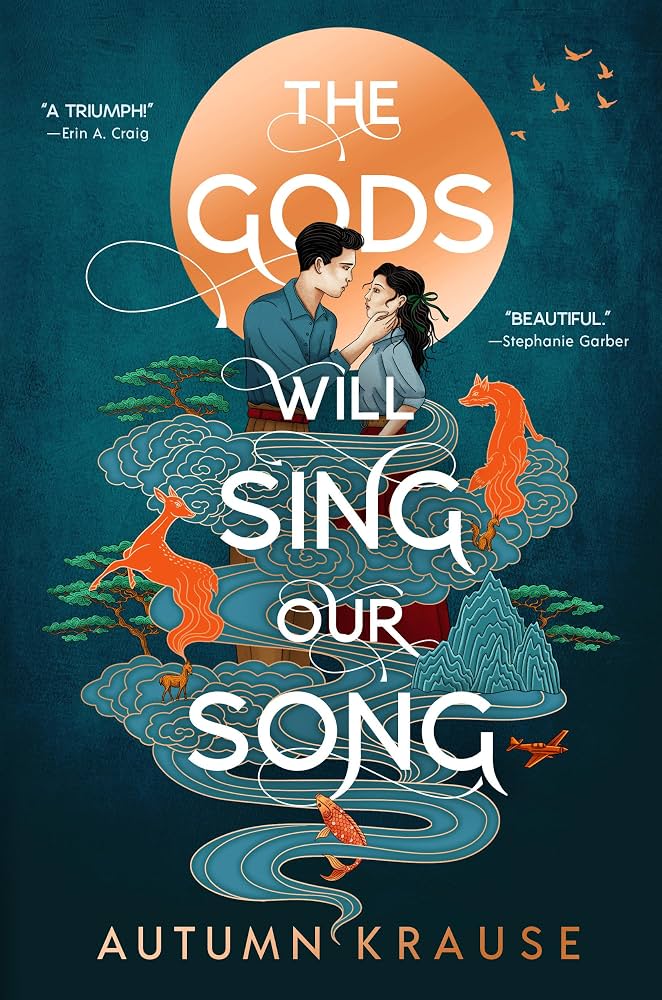
The Gods Will Sing Our Song by Autumn Krause is a YA historical fantasy romance about two Japanese American teenagers, Ren and Violet, who are imprisoned in an internment camp during World War II. Against this devastating backdrop, they find themselves drawn to one another while confronting uncertain futures and a strange magic tied to their cultural heritage. Both are living through a moment that has stripped away so much of their freedom, dignity, and safety. And yet, they are still teenagers who fall for each other, dream about what comes next, and find moments of beauty within circumstances designed to deny them exactly that.
Magic, in this city of oranges and opportunity, is like that big black dot you see after looking at the sun. It’s the aftereffect of something brilliant, a negative image that’s dwindled over time.
Autumn Krause, The Gods Will Sing Our Song
One of the things I appreciated most about this book is how approachable it makes this history without ever making it feel less horrific. I knew about the internment of Japanese Americans during WWII, but I realized while reading that I couldn’t think of another novel I had read centered on it. Whether that says something about my own reading or about how few of these stories reach a wide audience, I’m not sure. Either way, this feels like such an important entry point. Krause gives us a story we can move through within the covers of a single novel while still asking us to sit with how something this unconscionable was allowed to happen at all.
Part of what makes all of this work so well is Krause’s prose. Her writing is so vivid and distinctive that there were moments I had to stop just to appreciate the images she created. At one point, Ren thinks, “I’m going to punch him in the mouth and watch his teeth drop like autumn leaves,” and I have genuinely not stopped thinking about it. The gruesomeness of that potential violence juxtaposed with something as beautiful and inevitable as falling autumn leaves? What an image! And that’s just one example. That kind of unexpected juxtaposition happens again and again, giving the writing this gorgeous sharpness even when the story itself is painful.
If you understand only your own side and cannot grasp the other, I fear you can’t say you know either one, yours or theirs.”
Autumn Krause, The Gods Will Sing Our Song
I also loved the yearning between Ren and Violet. Their romance is incredibly sweet, even as they live through something so dehumanizing and terrifying. They’re teenagers who want to flirt, fall in love, spend time together, and imagine what their lives might look like in the future. There’s something important about how familiar those desires feel. History can flatten people into what happened to them, especially when we’re looking back at an atrocity from decades ago. But we understand what it’s like to have a crush, to wonder if someone likes us back, to imagine a future we haven’t lived yet. And that recognition closes some of the distance between reader and history. Alongside the profound violations of freedom, dignity, safety, and autonomy, the novel reminds us of all the ordinary, deeply human parts of a life that internment disrupted, too.
Knowing that Krause drew from her own family’s experiences made the story even more affecting for me. There is something so powerful about taking an inherited family history this painful and turning it into a story that can carry those experiences forward. These histories deserve to be remembered, especially when forgetting makes it easier to distance ourselves from how something like this was even allowed to happen in the first place. I thought Krause honored the people who lived through internment while still asking difficult questions about the fear, racism, and failures that made it possible.
Some people go to war out of hate. But some people go to war out of love.
Autumn Krause, The Gods Will Sing Our Song
My one real wish is that we had gotten more of the fantasy and mythology. The gods, relics, and culturally rooted magic were such a compelling way into Japanese traditions, and I would have loved to see that part of the story developed even further. At the same time, I understand how much the novel is already balancing between its historical, romantic, and fantastical elements. Mostly, I wanted more because I was so interested in what was already there.
Overall, The Gods Will Sing Our Song is a triumph! It finds beauty without romanticizing its history, hope without diminishing the horror, and tenderness in a story about people whose humanity was so profoundly disregarded. It makes this history approachable without making it easy, and I’m incredibly glad I got to read it.
Thank you to NetGalley and Delacorte Press for sharing an advanced reader copy of this book in exchange for an honest review.