
Book Review

Every Exquisite Thing by Laura Steven

Every Exquisite Thing by Laura Steven is a sapphic young adult dark academia retelling of The Picture of Dorian Gray by Oscar Wilde. (There’s NO WAY I could resist a premise like that!) The novel follows Penny Paxton, who arrives at the elite Dorian Drama School convinced it will transform her into someone beautiful enough, talented enough, and unforgettable enough to matter. As the daughter of a famous supermodel, Penny already understands the brutal logic of her world: beauty is currency, and for women and girls, it can feel like the only path to power or control. But as Penny chases perfection, she quickly discovers all that glitters is not, in fact, gold. It’s something far more sinister and rotten that has been waiting to consume girls like her.
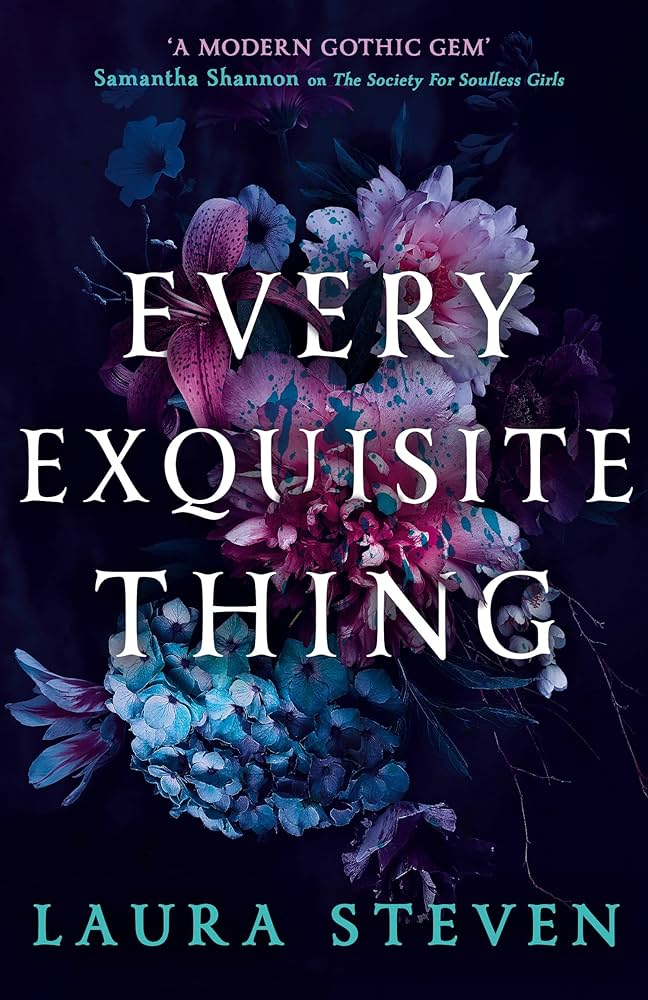
Book cover for Every Exquisite Thing by Laura Steven.

Girls want power. And sometimes beauty is the closest substitute.

Laura Steven, Every Exquisite Thing

Every classical novel has inevitably inspired retellings, reimaginings, and the occasional “what if we made this gayer?” reinvention. But the best ones don’t just swap names and settings. They figure out what made the original story endure, then twist that question toward a different wound. Every Exquisite Thing does exactly that. Steven takes the old Dorian Gray question, “what would you sacrifice to stay beautiful?” and gives it to girls who have already been taught that beauty is the thing most worth sacrificing for. Wilde’s Dorian is a beautiful young man whose face allows him to move through society untouched while his portrait bears the evidence of his corruption. Penny’s version of that bargain is different because her desire for beauty has been trained into her long before anything supernatural enters the picture. Penny wants beauty because she has inherited a world that treats it as evidence of value. The real tragedy is that she has been taught to confuse being beautiful with being worthy.

Penny is a really compelling FMC for this kind of story because her vanity is so familiar. She is ambitious, jealous, insecure, hungry, and sometimes (especially at the beginning of the novel!) so deeply unlikable I wondered how long I could sympathize with her. But as the story unfolds, it becomes harder to separate Penny’s worst impulses from the world that taught her to survive this way. She has grown up close enough to fame to understand its power, but not close enough to feel secure in it. That juxtaposition gives her obsession with beauty and perfection the rancid edge of a survival instinct gone septic. She wants the lead role. She wants the perfect body. She wants the stunning face. She wants proof that she isn’t just someone’s daughter. And Steven is very good at showing how that desperation can curdle into cruelty without flattening Penny into a cautionary tale.

My grandmother, meticulously measuring herself with a pink dressmaker’s tape, and my mother, observing, internalizing. A generational curse passed down like a set of ancient pearls, impossible to escape from once they were hanging around your neck.

Laura Steven, Every Exquisite Thing

One of my favorite parts of Every Exquisite Thing is how pointed the Shakespeare productions feel in a story about girls learning which versions of themselves are allowed to exist. Steven is reimagining Wilde rather than simply performing Dorian Gray back to us, while the students are doing the opposite with Shakespeare: stepping into scripts that have already been written, studied, admired, and repeated for centuries. So the school’s emphasis on performance goes far beyond the stage. Everyone is learning how to fit themselves into roles other people already understand. Penny’s casting as Lady Macbeth makes that even more pointed. Lady Macbeth knows what it means to want power from a position where she cannot simply claim it outright, and Penny is rehearsing that same impossible lesson: how to want something without being punished for wanting too much.

I also really liked that the sapphic relationships are not treated like a glossy update to a classic text. They are messy, charged, and tangled up in the same questions of beauty, wanting, and self-image that shape the rest of the novel. The Picture of Dorian Gray has always felt deeply queer to many readers, even when its queerness lives in implication, obsession, secrecy, and the fear of being exposed. Every Exquisite Thing brings that desire into the open. In a world where girls are constantly taught to measure themselves through desirability, attraction can blur very quickly with admiration, envy, rivalry, and hunger. Sometimes these characters want each other. Sometimes they want to beat each other. Sometimes they want to become each other. And sometimes all of that is happening at once. Queerness here is not an escape from the beauty economy. It disrupts it and shows how difficult it can be to desire someone clearly when you have been taught to compare yourself to everyone.

I was so perfect before the world told me otherwise.

Laura Steven, Every Exquisite Thing

The portrait itself also gets a smart modern update. Wilde’s portrait can be hidden away, left to rot in private, while Dorian’s face remains untouched. Steven understands that contemporary image culture does not work like that. In Penny’s world, beauty is documented, circulated, screenshotted, weaponized, and preserved by everyone with a phone. A photograph can be evidence, social currency, punishment, or proof of who someone is supposed to be. That makes the portraits feel even stranger when they appear because they’re not just gothic decoration. They are part of a much larger ecosystem of images haunting these girls from every angle. Mirrors, photos, paparazzi shots, portraits on the wall—all of them become versions of the same question: what happens when the image becomes more powerful than the person it claims to capture?

By the end, Steven has created a retelling that feels more like excavation than homage. She does not simply ask, “What if Dorian Gray were sapphic?” Instead, she imagines what Dorian Gray becomes in a world where girls are taught to curate themselves before they know who they are, and where beauty is marketed as empowerment while still being used as a leash. The result is gothic, bitter, romantic, and vicious in all the right places. I absolutely devoured this book, and so will you!

Thank you to NetGalley and Wednesday Books for sharing an advanced reader copy of this book in exchange for an honest review.

Book Review

Babel by R.F. Kuang

Babel by R.F. Kuang is a dark academia historical fantasy about language, empire, and the uneasy relationship between knowledge and power. I think what surprised me most about this novel is how gripping it is despite how dense it can be. This is a long, research-heavy novel about translation, colonialism, and academia that reads like historical fantasy on the surface. Underneath, it feels like a sustained argument about language and power, wrapped inside a dark academia setting that the book both loves and interrogates at length. Kuang invites readers to admire the beauty of scholarship while also confronting the systems that make that beauty possible, which gives the entire book a sense of urgency and forward motion.

Book cover for Babel by R.F. Kuang set against a pink background.

Translation means doing violence upon the original, means warping and distorting it for foreign, unintended eyes. So then where does that leave us? How can we conclude, except by acknowledging that an act of translation is then necessarily always an act of betrayal?

R.F. Kuang, Babel

One of the ideas that runs through the entire story is that language is never neutral. In Kuang’s version of Oxford, translation quite literally fuels empire through silver-working, a magical system powered by the subtle gaps between languages. It is such a smart way to make an abstract idea feel tangible. Language already shapes whose histories are recorded, whose stories are believed, and whose perspectives are centered. The novel simply makes that power visible.

The book also feels very in conversation with criticisms of the dark academia aesthetic in general. The libraries and lecture halls remain intoxicating and nostalgic, but the story refuses to romanticize the institution behind them. Academia is shown as a place that produces knowledge while also benefiting from colonial extraction. That tension gives the novel a sense of urgency that feels very current.

English did not just borrow words from other languages; it was stuffed to the brim with foreign influences, a Frankenstein vernacular. And Robin found it incredible, how this country, whose citizens prided themselves so much on being better than the rest of the world, could not make it through an afternoon tea without borrowed goods.

R.F. Kuang, Babel

While reading, I kept thinking about Ngũgĩ wa Thiong’o’s Decolonising the Mind (even though the text isn’t directly referenced). His argument that language carries culture, hierarchy, and systems of domination feels central to every character arc. Separate from Ngũgĩ’s work, but very much in conversation with it, is the historical reality that colonial translation was rarely neutral or precise. British officials often depended on local printers, teachers, and scholars to translate English texts into regional languages, and because those officials were not fluent themselves, the results could be uneven, interpretive, or simply wrong. Those translations were then printed and reprinted until they became their own authoritative versions. Even Shakespeare exists in radically different forms across languages because of this history. That reality makes the novel’s focus on translation feel especially sharp. Language becomes both a tool of control and a site of slippage. Over time, that same linguistic space was sometimes used to resist colonial oppressors. People learned the language of power and then used it in ways the empire never intended. The characters in Babel follow that same trajectory as they begin to realize that the skills meant to sustain the system might also be used to challenge it.

The question of violence sits at the center of the novel and will likely be the most divisive aspect. Kuang pushes the story toward a conclusion that refuses easy or comfortable resolutions. One line in particular captures the book’s moral tension perfectly:

This is how colonialism works. It convinces us that the fallout from resistance is entirely our fault, that the immoral choice is resistance itself rather than the circumstances that demanded it.

R.F. Kuang, Babel

That idea connects closely to the novel’s recurring claim that translation is a form of betrayal. Every act of translation alters the original, reshaping it for new audiences and new purposes. By the end of the novel, that concept extends beyond language. The characters themselves are forced to confront what it means to reshape their loyalties, their identities, and the institution that shaped them.

It’s also worth noting that Kuang’s style may not work for every reader. The narrative includes footnotes, linguistic digressions, and historical context that slow the pacing at times. For me, this was one of the book’s strengths. I studied postcolonial theory during my doctoral work, so the intellectual foundation felt purposeful and familiar rather than overwhelming. I think the academic texture gives the novel a sense of conviction that fits its subject.

What stayed with me most after finishing Babel is how deliberately it dismantles the romantic fantasy of academia while still acknowledging the beauty of language itself. The book never suggests that learning, scholarship, or translation are inherently harmful. Instead, it asks what happens when those pursuits are shaped by systems of power and inequality, and it pushes that question toward an agonizing conclusion. It is a dense and demanding novel, but also a deeply rewarding one. It feels especially resonant right now, and it left me thinking long after the final pages.

Book Review

House of Marionne by J. Elle

Seventeen-year-old Quell has spent her life in the shadows, fleeing from city to city to hide the forbidden magic coursing through her veins. But when her secret is discovered, and her mother’s life hangs in the balance, Quell is forced into the gilded world of the Order, a high-society magical debutante system where the stakes are as deadly as they are dazzling. To survive, she must navigate the Order’s trials, master new forms of magic, and resist the allure of her handsome, shadow-wielding mentor—all while concealing her own outlawed powers. But as the dark truths of the Order unravel, Quell faces an impossible choice: tame the magic she fears, or embrace the monster within.

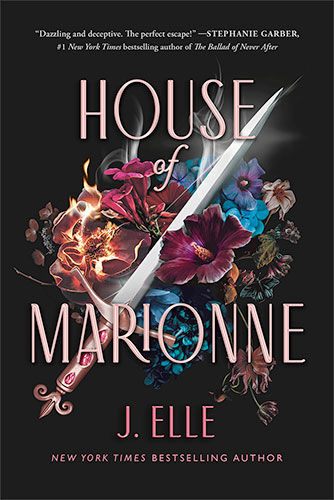
Book cover for House of Marionne by J. Elle.

I’ve done it. I’ve stepped into this world we’ve spent our entire lives running from. There’s no turning back now.

J. Elle, House of Marionne

In House of Marionne, author J. Elle offers an ambitious mix of dark academia, magical intrigue, and an enemies-to-lovers romance. While its premise is captivating, the story doesn’t fully deliver on its promise. The concept of toushana magic—a cornerstone of the story—is underexplored, leaving readers with more questions than answers. The visual idea of diadems and masks as manifestations of mature magic is intriguing (if uncomfortably gendered), but the logic behind them feels incomplete. For instance, the practicalities—like how they impact daily life or sleep—are glossed over. I kept wondering how no one ever got their hair tangled in a diadem! (Magical reasons?) This lack of clarity makes the world-building feel more like a collection of ideas than a cohesive system.

The characters fare slightly better, though still not without their flaws. Quell is a strong, determined protagonist, but her decisions—especially her quick trust in her suspicious grandmother—don’t always align with her survivalist upbringing. Jordan, her mysterious love interest, is a mix of brooding intensity and trope-heavy predictability. He seems designed to evoke fan-favorite archetypes like Rhysand (A Court of Thorns and Roses) or Xaden (Fourth Wing) but falls short of their depth and charisma. Yagrin, a fascinating side character with the potential to steal the show, is frustratingly underutilized. It’s easy to imagine a version of the story from his perspective being far more compelling.

The novel’s writing style is accessible and engaging, though it skews toward a middle-grade tone despite its young adult (YA) label. This lighter touch makes the book easy to read but also limits its emotional resonance and complexity. For instance, many of the lines where Quell describes how she views Jordan physically are so beautiful, but the writing never fully convinces me of their deeper connection. The narrative leans heavily on familiar YA fantasy tropes, and while these elements create a solid framework, they lack the originality or depth needed to stand out. As a result, the attempt to weave in themes of power and danger also often feels surface-level, relying more on atmosphere than substance.

She is fury and determination. Insatiable at times, and intensely powerful. She is also destruction. But some things deserve to be destroyed.

J. Elle, House of Marionne

Ultimately, House of Marionne knows its audience. For readers looking for a fast-paced story with a magical setting, forbidden romance, and high-stakes danger, it delivers. The Order’s glitzy debutante culture and deadly secrets provide an atmospheric backdrop, and the romance, while not groundbreaking, has its moments. Casual readers who enjoy YA fantasy for its escapism and drama will likely find the book entertaining. However, for those seeking deeper world-building or more complex characters, the charm of this book will likely feel more like a spark than a flame.

Thank you to NetGalley and Razorbill / Penguin Random House for sharing an advanced reader copy of this book in exchange for an honest review.