Book Review

You Won’t Forget Me by Mazey Eddings

You Won’t Forget Me by Mazey Eddings is a sapphic summer romance about Cubby Clark, a musician whose band is finally getting some real attention, partly because the Internet has misread a moment between Cubby and her bandmate as romantic. The band decides to lean into it, turning a fake relationship into a PR strategy that could help get their music heard. But a fake PR strategy still involves real feelings (and, arguably, a love trapezoid?). And the longer Cubby performs that version of herself, the harder it becomes to ignore the real question underneath it all: How much of yourself can you keep pretending away before the act costs more than it’s worth?

Book cover for You Won't Forget Me by Mazey Eddings against a pale yellow background.

What the hell were we thinking? Why the fuck did I, a straight woman, hook up with my similarly straight best friend?

Mazey Eddings, You Won’t Forget Me

One of the things I loved most about this book is how Cubby isn’t a neatly packaged romance heroine who has already metabolized all her pain into charming self-awareness. Eddings lets her be difficult, tender, funny, self-sabotaging, brilliant, overwhelmed, and wildly human all at once. And just as you get swept up into the intensity of her highs and lows, you’ll end up catching yourself in the act of judging her for it all. You’ll slow down and really look at everything she’s dealing with. She’s being ruthlessly picked apart online, shoved into public narratives she didn’t fully choose, and trying to understand her sexuality while clearly struggling with depression. Of course she’s going to be a little messy!

But that’s where Eddings’ characterization feels so thoughtful to me. She isn’t flattened into a quirky disaster girl or a misunderstood tortured artist. There are so many layers to Cubby, and that’s what makes her feel so singular. It’s like Eddings papier-mâchéd her together with so much care and attention, building her out of scraps of rage, humor, loneliness, desire, defensiveness, talent, and aching vulnerability until there is no way you could find a dupe of her in another book. She is not designed to be effortlessly likable. She is designed to be recognized, familiar, and known. What a gift of a character!

Creating something always feels like breaking a bone just to document its healing… And sometimes it’s hard to pick which bone to break.

Mazey Eddings, You Won’t Forget Me

The romance itself also has that fizzy, stomach-flipping quality that makes a book like this so fun to read. All the yearning and lingering gazes are delicious, and the love scenes possess a rare sensory quality where it feels like someone else bit into a piece of fruit, but somehow the burst of flavor registers across your own tongue. There is heat, obviously, but there is also emotional texture. The intimacy feels connected to Cubby’s larger awakening, to the terrifying thrill of wanting something she has not fully let herself name, and to the way desire can make the body admit what the mind is still trying to argue with. Truly, what’s a little heavy snogging and shared orgasms between besties, right?

But the piece that really made this book sing for me was the way it handles creativity. The song lyrics function like pressure points where everything Cubby cannot say directly gets translated into music. Eddings shows how lyrics are layered in the way all art is layered: the listener hears one thing, the writer may have meant another, and somewhere between them is a third meaning neither person fully controls. The book beautifully captures the mysterious, gorgeous, vulnerable work of mining the most fractured yet whole and truest pieces of yourself to make something honest enough to reach another person.

Pride is, and always has been, a protest, a commitment to being your truest self regardless of the bigotry, the risk of hate and violence, from others.

Mazey Eddings, You Won’t Forget Me

By the end, You Won’t Forget Me left me with that rare, giddy feeling of having read something that understands both the thrill and the terror of becoming more honest with yourself. It’s sharp, swoony, and easy to devour. A perfect Pride Month read, but also the kind of summer romance that makes you want to roll down the windows and play the music too loud. My first Mazey Eddings read, and definitely not my last!

Thank you to NetGalley and St. Martin’s Press for sharing an advanced reader copy of this book in exchange for an honest review.
Book Review

This Spells Love by Kate Robb

What if one impulsive, margarita-fueled decision could wipe away your worst heartbreak—but at the cost of everything else? In This Spells Love, Kate Robb blends romantic comedy with a dash of magical realism to explore what happens when one woman’s attempt to forget her ex rewrites her entire reality. After a drunken spell with her best friend Dax, her sister, and her eccentric aunt, Gemma wakes up in a world where her ex never existed, her life is nearly unrecognizable, and the one person who’s always mattered most—Dax—no longer remembers her at all. Whimsical and heartfelt, this debut asks a compelling question: if you could undo the past, would you still choose the same future?

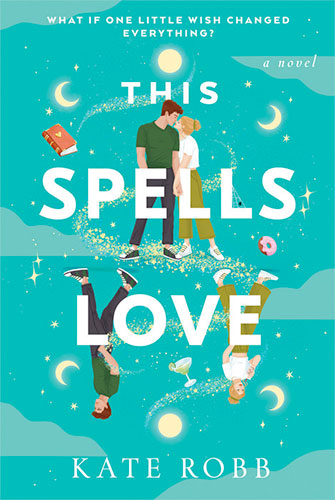
Book cover for This Spells Love by Kate Robb.

It’s like Hot Tub Time Machine without the hot tub.

Kate Robb, This Spells Love

There’s real charm in the setup, and the pacing is strong throughout. Robb’s prose is breezy and digestible, with writing that makes it easy to devour chapters without realizing how much time has passed. The magical realism element is understated, more a plot device than a full-on genre shift, which works well for readers who prefer grounded rom-coms. And at its core, the novel is about more than romantic love. It’s about learning to recognize your blind spots, appreciating the people who anchor you, and understanding that healing doesn’t come from rewriting the past. It comes from making peace with it.

But for all its strengths, This Spells Love stumbles where it matters most: character depth. Gemma, as a narrator, is often difficult to root for. Her self-absorption borders on grating, and while the story hinges on her personal growth, it’s hard to feel invested in that journey when she seems oblivious to the emotional needs of those around her. She treats her support system like background noise and rarely reflects on how her actions impact others until late in the book. While this is realistic in some ways, it doesn’t always make for compelling reading.

The side characters—particularly Gemma’s sister and aunt—feel one-dimensional. They appear when needed, serve their purpose, and then retreat until the plot calls for them again. Even Dax, who is arguably the emotional anchor of the novel, is frustratingly underdeveloped. Because the majority of their romance happens in an alternate reality where he’s essentially a different person, the emotional stakes never quite land. The book gestures at a best-friends-to-lovers arc, but it lacks the lived-in warmth and history that make those stories shine. There’s no satisfying build-up to the chemistry; we’re simply told it exists, and then expected to believe it transcends timelines.

The predictable path is boring. And you miss out on the chance to try some really incredible things.

Kate Robb, This Spells Love

That said, there’s something endearing about the concept itself. The idea that love can survive (thrive!) through a fractured reality is a powerful one. And while the execution is imperfect, the themes resonate. Gemma’s realization that Dax is her constant, the one person who feels like home no matter the version, lands with a quiet poignancy. It’s not quite the sweeping romance it could have been, but it’s earnest. And sometimes, that’s enough.

This Spells Love is a flawed but engaging debut. It may not deliver on all its witchy promises, and it might leave some readers wanting more from its characters and emotional arcs. Still, for an afternoon curled up with something light and slightly magical, it scratches the itch for cozy fall vibes. Just don’t expect potions, pentagrams, or a deeply fleshed-out love story. This one’s more about the lesson learned than the spell cast.

Thank you to NetGalley and Dial Press / Random House Publishing Group for sharing an advanced reader copy of this book in exchange for an honest review.

Book Review

The Pairing by Casey McQuiston

In The Pairing, Casey McQuiston serves up a story of lust, longing, and languid food tours through Europe, all wrapped in the undeniable queerness that has become their signature. Theo, an aspiring sommelier, and Kit, a pastry chef, find themselves accidentally reunited on the food and wine tour that marked the end of their relationship four years prior. What starts as a hookup competition to prove they’re over each other soon unravels into a complicated mess of unresolved feelings and sexual tension. With scenic backdrops and sumptuous descriptions of food and wine, McQuiston delivers an enticing setup—but does the romance sizzle or fizzle?

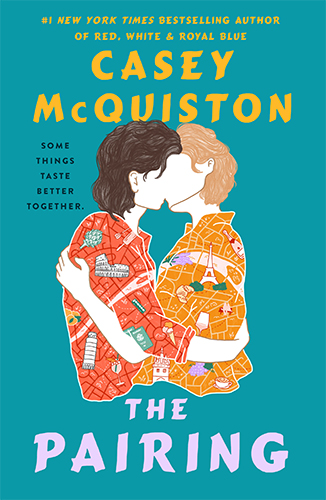
Book cover for The Pairing by Casey McQuiston.

I’ve always agreed with the French that a meal should begin with sweetness, but I’m beginning to wonder if the Italians had it right—if, sometimes, discovery wants bitterness first.

Casey McQuiston, The Pairing

McQuiston deserves praise for the unapologetically queer heart of The Pairing. Particularly, the scene where Theo comes out to Kit as nonbinary is handled with thoughtfulness and care, and their pronoun switch midway through the story feels authentic and affirming. Theo’s vulnerability in sharing their identity with Kit creates some of the novel’s most tender moments. Kit shows all the unconditional support and encouragement anyone could hope for, and it completely melted my heart! It’s rare to find queer representation so layered, deliberate, and nuanced, and McQuiston nails it here.

Unfortunately, the novel stumbles in crafting compelling characters beyond their queerness. Theo’s privilege as a “nepo baby” who opts to stay poor and struggling despite several people offering to help them throughout the entire novel feels contrived and frustrating. Their refusal to leverage their family’s wealth for the sake of so-called authenticity or some misplaced sense of validation or merit borders on tone deaf and feels hollow, especially when juxtaposed with their ability to casually flit through European cities. This, combined with their insufferable self-pity, makes it difficult to root for them.

Sometimes I think the only way to keep something forever is to lose it and let it haunt you.

Casey McQuiston, The Pairing

Just when all of Theo’s internal struggles and bad decisions have them primed for some significant growth, the story abruptly shifts to Kit’s perspective halfway through the novel, undercutting any meaningful resolution. Kit, while less grating, brings little complexity to the table, beyond his complete and total adoration (infatuation?) for Theo. Together, their chemistry leans heavily on physical attraction, and the emotional weight never lands. Theo and Kit keep circling around the same issues, avoiding the hard conversations that would make their reunion satisfying. By the end, I was left craving more substance—something to make their love story feel earned.

With its vibrant cities and decadent meals, the European backdrop offers a feast for the senses; however, the execution—while meticulously researched—feels superficial. The bacchanalian parade of food, booze, and hookups quickly grows repetitive. I think this is partially because Theo and Kit don’t really develop, so it feels like nothing advances the plot. The tour becomes just as redundant as every scene between the two leads. The characters’ romanticized, tourist-like experience of Western Europe also leaves little room for authentic exploration of various cultures and cuisines. Furthermore, their near-magical ability to charm their way into every bed and social circle simply isn’t realistic. While escapism is often part of romance’s appeal, the sheer perfection of every encounter makes this story feel flat and predictable.

If I can give my whole heart to love without fearing the cost, I will regret nothing.

Casey McQuiston, The Pairing

The Pairing struggles to balance its frothy, sexually charged premise with the deeper emotional work necessary for a satisfying second-chance romance. Some moments in Theo and Kit’s inner monologues are achingly beautiful—one, in particular, stands out when Kit sees Theo in Botticelli’s The Birth of Venus, a depiction of the divine feminine, while imagining Theo admiring Michelangelo’s David, a tribute to masculine beauty. Kit wonders, with quiet longing, if Theo also finds pieces of them both reflected in the David. How romantic to discover your lover—and yourself—in the world’s most iconic works of art! Yet moments like this remain internal; the characters never bring such revelations into their shared conversations or let them deepen their connection beyond physical desire.

McQuiston’s hallmark wit and charm, evident in earlier works like Red, White & Royal Blue and One Last Stop, are present but not as pronounced here. Some lighthearted moments occasionally sparkle, but a frustrating lack of narrative depth overshadows them. For readers new to queer romances or those looking for lighthearted escapism, The Pairing might hit the right notes. But for anyone seeking the heartfelt intimacy and layered storytelling that define McQuiston’s best work, this book might feel more like a missed opportunity than a perfect pairing.

Thank you to NetGalley and St. Martin’s Press for sharing an advanced reader copy of this book in exchange for an honest review.